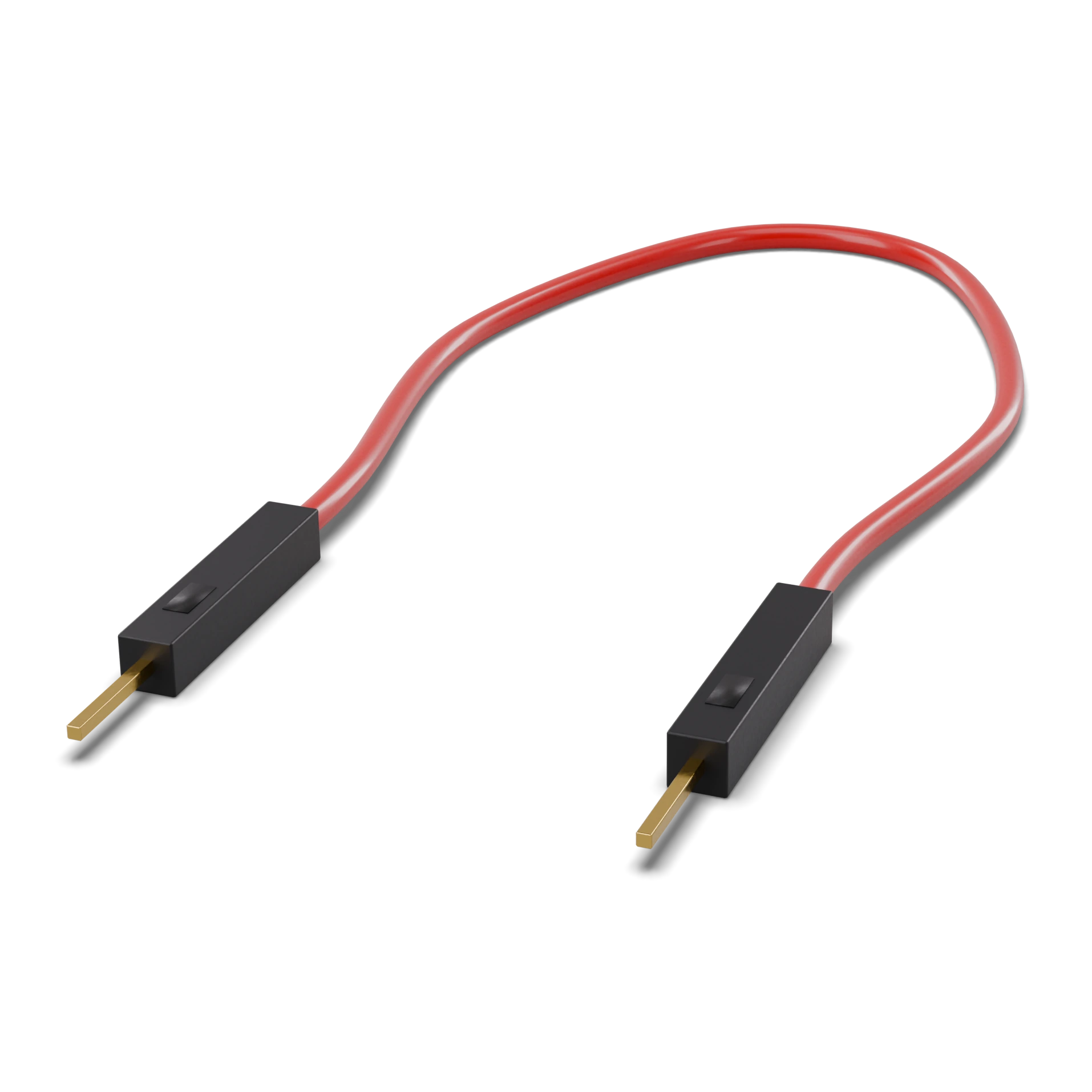
Wire (stranded, PVC) · typically 20 cm, AWG 26Plastic housing (Dupont) · 2.54 mm spacingMale pin (gold-plated) · 0.64 mm square
- 1Wire (stranded, PVC) · typically 20 cm, AWG 26
- 2Plastic housing (Dupont) · 2.54 mm spacing
- 3Male pin (gold-plated) · 0.64 mm square
Colored wires, with a metal pin or socket inside a black plastic housing at the ends
Lead spacing 2.54 mm; length 10–30 cm is common
Lead spacing 2.54 mm; length 10–30 cm is common
Jumper wire
In simple terms
What is this?
A small flexible colored wire that connects connection points to each other.
What is it for?
Makes temporary solderless connections between the breadboard and modules.
Where do you see it?
In Arduino and module kits; looks like the ends of a case's front-panel wires.
How do you spot it?
Thin colored wire with a plastic housing at each end; the tips are metal pins or sockets.
Caution:
Colour carries no electrical meaning; using red for plus and black for minus reduces mistakes.
Technical definition
A short connecting wire with a pin or socket at each end. The male end goes into a breadboard hole, the female end onto a module's pin header. The color has no electrical meaning, but using red for plus and black for minus reduces mistakes.
TerminalsM-M · M-F · F-F
Range2.54 mm
ColorRed + · black −
Schematic symbol Same in IEC and ANSI
IEC 60617: the drawing style used in Türkiye and Europe.
Pins 3
1Male end (pin)Fits into a breadboard hole or a female socketE
2Female end (socket)Plugs into the pin header on the moduleD
3Cut solid-core wireFor flat, tidy connections on a breadboardAWG
Features typical
- Types
- Male-to-male · male-to-female · female-to-female
- Lead spacing
- 2.54 mm (pin header)
- Dupont wire
- Thin, stranded
- Cut-to-length wire
- 22 AWG solid-core
- Current
- Low; thick wire for power lines
- Example part
- Dupont male-to-male, 20 cm
Common mistakes
Not noticing a wire broken insideCheap jumpers can break inside and the circuit won't work. Check any wire you suspect with the multimeter's continuity mode.
Using colors at randomIf everything is the same color, finding faults gets hard. Let red be positive, black negative, and other colors signals.
Passing motor currentA thin jumper heats up at high current and loses voltage. Use thick wire for motor and power lines.
Where it is used
Breadboard connectionsConnecting the module to a microcontrollerTemporary bridge for measuring
Related lessons