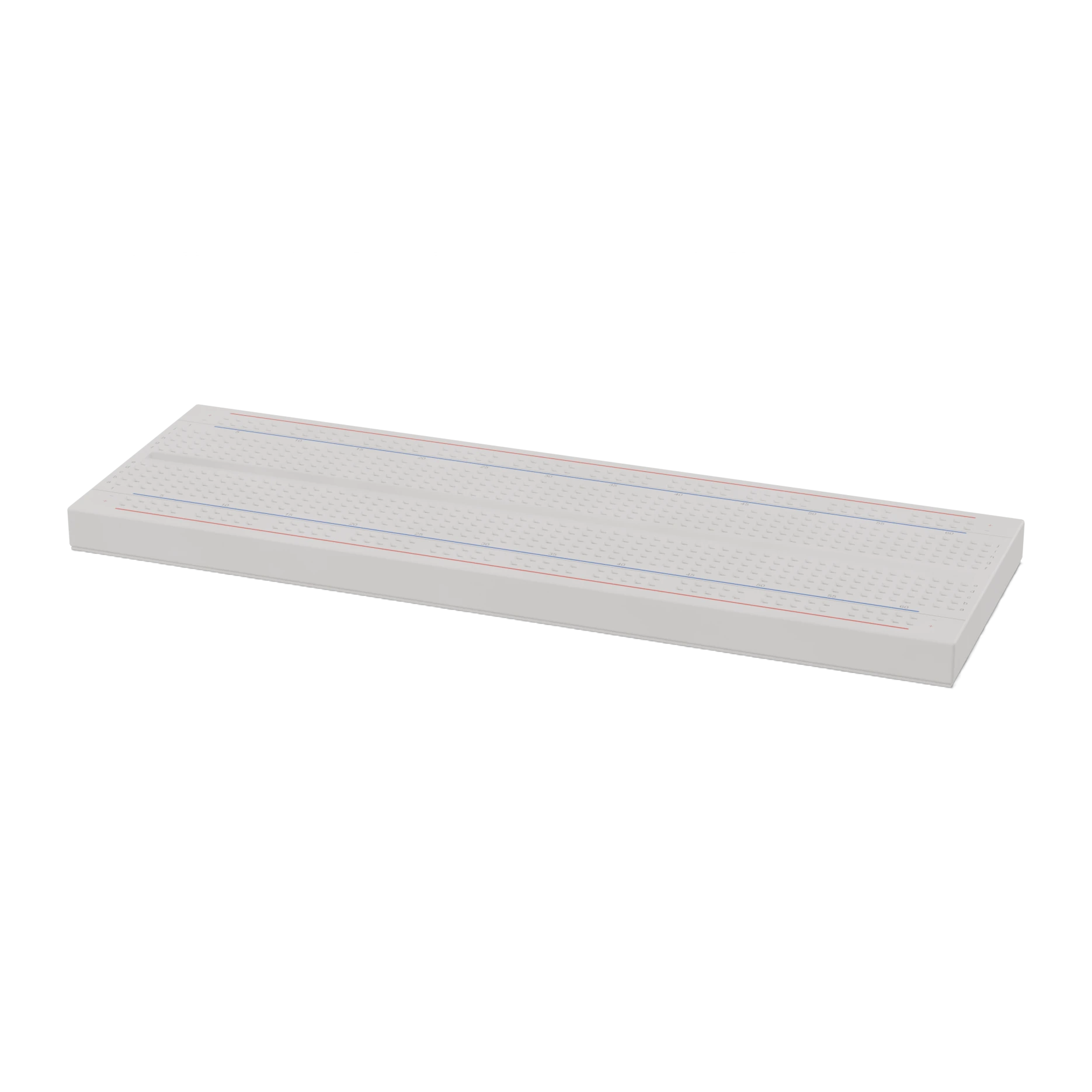
Column numberConnection strip (a–e) · 5 holes connected to each otherCenter channel · 7.62 mm (DIP spacing)+ power rail− power rail
- 1Column number
- 2Connection strip (a–e) · 5 holes connected to each other
- 3Center channel · 7.62 mm (DIP spacing)
- 4+ power rail
- 5− power rail
White plastic board, numbered columns, a-j rows, red and blue rails at the edges
830: ≈ 165 × 55 mm · 400: ≈ 82 × 55 mm
830: ≈ 165 × 55 mm · 400: ≈ 82 × 55 mm
Breadboard (830 / 400)
In simple terms
What is this?
A solderless breadboard; its holes are grouped by metal strips inside, like a road map.
What is it for?
Lets you plug in parts without soldering, so you can try out and change a circuit.
Where do you see it?
School labs, hobby boxes and Arduino kits.
How do you spot it?
A white plastic rectangle with a gap in the middle, rails with red and blue lines at the edges, rows of holes.
Caution:
Holes in the same column are connected; if you plug two pins into the same column, it becomes a short circuit.
Technical definition
A solderless prototyping board where the holes are connected in groups by spring metal strips inside. In each middle column, holes a-e and f-j are connected among themselves; the center channel separates these two groups. The long rails at the edge are for power.
Hole830 · 400
Range2.54 mm
Center channel7.62 mm
Pins 5
1Terminal strip (a-e)The five holes in each column are connected insidea-e
2Terminal strip (f-j)The five holes in each column are connected insidef-j
3Positive rail (+)Connected along the red line; supply positive+
4Minus rail (−)Connected along the blue line; GND−
5Center channel7.62 mm; DIP ICs sit on thisDIP
Features typical
- 830 holes
- 63 columns × 10 + 4 rails × 50
- 400 holes
- 30 columns × 10 + 4 rails × 25
- Hole spacing
- 2.54 mm
- Center channel
- 7.62 mm
- Suitable wire
- ≈20–29 AWG solid-core
- Usage
- Low voltage and low current; never mains
- Example part
- MB-102 (830 holes)
Common mistakes
Missing split railsSome long breadboards have split rails. Join the halves with a wire; if unsure, test continuity.
Putting both legs in the same columnHoles in one column are connected; both resistor pins in one column create a short circuit, making the resistor useless.
Forcing thick legsThick legs loosen the springs and cause contact problems later. Connect these parts by adding thin wire.
Where it is used
Building test circuitsLesson experimentsTest your circuit idea before soldering
Related lessons